Showing posts with label Learning Process. Show all posts

Saturday, March 24, 2012

My Project Idea

I think that perhaps for my project I will do a twist on our own class project. If I can get all the people I'm going to contact to consent, I think that perhaps I can do a collaborative video presentation about the significance of the digital humanities. I can ask a specific question to each "guest speaker" and have them record their response on video and send that to me. Then, perhaps, I can combine each segment together into one larger project. It can be all fancy and digital and pretty and...several other adjectives I can't htink of

Does that sound like a good idea?

And I think that perhaps if I can get more of the general publice (students/people interested in the digital medie, etc.) to accept my inquiries, I can do something similar with them. That way I can observe the different viewpoints and address the struggles and questions people may have about digital humanities.

Maybe make this a web series or something?

What do you guys think?

Market Research Study/People I Want to Contact:


Okay. I 've been working rather hard to figure out who I will be able to contact and how I will contact them. I've decided that I want to display the community building power of the digital humanities as well as the learning power you can gain from employing digital means. I want to show how digital humanities enhance traditional studies and how beneficial they are to our current age.

I've noticed a few problems with the digital studies that I'd like to address:
-Why aren't the digital humanities more widely available to a more general audience?

And

-How can we promote the digital humanities to show to skeptics that this method/genre of study is significant and beneficial?

I've mulled over these questions and I've figured out that perhaps if I focus my attentions on a more informal audience and promote the digital humanities to them perhaps popularity will win over the more skeptical audiences. I also want to extend my feelers out to audiences who are studying the digital humanities in the digital world and interrogate (or simply question) their motives for studying the digital humanities as well as their desires for the future of digital studies, etc. Sound like a plan?

Well I like this plan anyway.

And here's who I plan to contact (so far anyway):

I stumbled across a blog from a woman/ professor who has devoted a great deal of time studying the digital humanities:

http://digitalscholarship.wordpress.com/

In this blog the creator, Lisa Spiro, hopes to study the digital humanities and the affect that they have on studies. She also hopes to promote digital scholarship and display the significance of the digital humanities to a wider audience.

Pretty cool right?

I hope that I can contact her and get her insight on how she hopes to achieve these things. I'm working through her blog right now, but I would love to do an interview with her through e-mail.

And as a added bonus, her blog led me to several other blogs with people who are hoping to achieve similar things! I haven't worked through all of the individual blogs yet but I have a few that are extremely promising:

http://academhack.outsidethetext.com/home/

This blog, created by David Perry (a professor at the University of Texas), and he discusses his hope to cultural transformation brought about through the digital humanities. In his own words he states: " Particularly I am interested in how traditional institutions-libraries, higher education, even democracy itself-will be altered in a post print society. To see some of my work visit the research page."

He mentions that he has a twitter, so I'm hoping to follow him and start questioning him (okay maybe stalk him) in hopes to better understand his motives and insights. I'll also be perusing his blog and gaining a better understanding of his research.

Still another blog that I've come across is this:

http://www.dancohen.org/

This blog run by Dan Cohen (A professor at George Mason University) delves into the "impact of new media and technology on all aspects of knowledge, from the nature of digitized resources to twenty-first century research techniques and software tools to the changing landscape of communication and publication."

He teaches this at George Mason University and his blog is merely an extension of that reasearch. I'm also hoping to get an interview with him and propose several questions to him about making the technology for the digital humanities more cost effective and available to the the more general public.

And like I said there are many more blogs that I'm going through and I'll be sure to update another list of people when Iget more information on the creators and credibility of the blog list.

But, I do have a small problem that I'm not sure how to overcome. I keep thinking of ways to promote the digital humanities to people on a more common level, i.e. not professors or researchers, but people in general. I'm trying to get specific people/groups that I can interview, but I'm not quite sure how to go about things.

Any suggestions?


Tuesday, March 20, 2012

Video and short synopsis of my repurposed research

Alright. Let me just vent for a minute. I had an amazingly cool video to post for you filled with pictures and texts and all that wonderful stuff. I was rather proud of it actually. HOWEVER, like so many of my frustrations this last week, the stupid computer of mine didn't save things! Talk about frustratingly annoying.

Anyway,  I made a small video explaining, somewhat, my ideas about digital humanities. While the video isn't terrible I'm not too happy with the result and I feel as though I can be a lot more concise and tune my focus even further. That being said, this is a great jumping off point. Like I said though, my other video was much much better. Alas, 'tis not my lucky week. Oh well. Gotta roll with the punches, eh?

My main focus for the video, and I think for my research, is to focus on the benefits of digital studies. In particular I want to emphasize the ways digital humanities enhance traditional studies, as well as how the research community is more available. Because come on let's face it, it's always nice to know that there are people out there who actually CARE about what you're studying and talking about right? And I think that I'm going to take my focus away from strictly an academic community and focus more on the common, everyday people who are interested in employing digital studies into their learning. I want to show that digital studies (or studies in general) don't have to be limited to the upper crust of researchers. Everyone can study. Everyone can learn. And EVERYONE can share their ideas and become a part of the community.

Well that's what I think anyway.

Enjoy the video.

Tuesday, March 13, 2012

The Breadth and Depth of Digital Humanities & SHOUT OUT TO ASHLEY!

Okay!

As you may be aware from previous posts, I'm sort of addicted to the digital humanities. The whole concept to expand learning through the modern digital methods really intrigues me. And after working through my paper and listening to everyone's insight on reworking their own papers I've started to think about the different ways I can improve my own research.

One way that I thought about reworking my paper is to shift and expand my focus. I think my paper was very academically centered. My main focus was on talking to an audience of professors or researchers. I think that I need to expand this field a bit more and look at the broader scope of things.

I started by asked myself these basic questions:

Who has experience with the digital world?

-Just about everyone!

Who would be interested in digital studies?

-Students and teachers and people interested in learning.

HOW could digital humanities benefit?

-Digital Humanities can benefit people through the expansion of the knowledge base and the variety of information available. Further, studying through digital methods allow for different methods of study to present themselves providing unique opportunities for learners to understand the humanities in ways that appeal to individual learning habits and patterns as well a provide new insight into the basic foundation of studies in humanities.

So, in a nutshell, digital humanities provide a breadth and depth of knowledge and community connections that expand on traditional study methods.

Sound good?

Also, I thought that I could make my presentation more digital-friendly. How do you appeal to a digital savvy community about the importance of digital humanities unless you reach out to them through digital means? I'm not quite sure what avenue this will take just yet, but I'm starting to get things figured out slowly.

And ASHLEY,

I'd love to collaborate with you on our videos if you'd be willing. I know your ideas focus on Ophelia, but I think that there's a great many places where our ideas can overlap. Perhaps we can combine ideas in some way or present our videos as connectors to one another?

Let me know what you think!

Friday, March 2, 2012

Smile. It's Friday

Here's my plan for this weekend:

Do homework

Look at my paper again (I want to take Dr. Burton's suggestions and start to revise things to make them clearer)

Spend time with children

Take a nap

And I will be sure to laugh at some point.

I saw this the other day on facebook and thought I'd share:

Thursday, March 1, 2012

Reflections: Ode To a Research Paper

Well guys we did it! :)


I think we all should feel some sense of pride in all of our hard work. Each of us have researched, contacted others, blogged, and diligently attempted to create exceptional research papers. I say, everyone has done amazing!

Professor Burton asked that we all write a reflection on our process, our paper, and how we feel about things right now.

So, let's get started eh?

First of all here's a copy of my paper:

Digital Humanities

Honestly when I was working on this paper I sort of felt a little like a small fish in a big pond. The digital humanities is such a large and popular subject. I wanted speak intelligently about the grammar and linguistic aspect of the digital movement. So it was a little intimidating for me to sit down and write my paper. I worried that I wouldn't make sense in my writing and that I would sound foolish trying to talk about something so complex.

But I guess without any bravery we never know what we can accomplish eh?

So I continued on.

As for the completely product that you read? Well, I feel like maybe it is disjointed and that a lot needs to be reorganized. Professor Burton made some suggestions about how I can make my argument clearer and stronger and I can see that if I reworked the structure then my paper would sound stronger and be much more cohesive than it is now. Also, perhaps narrowing my focus even further than it currently is would help make my argument stronger.

I know that I can make my paper better than it is now. And I think that's a great aspect of writing, every time you complete a paper or a chapter in a novel, you are only finishing another DRAFT. You can edit and polish your paper later on and make things clearer, stronger, and better.

That thought cheers me up. I'm not saying that my paper is completely horrible. I don't think anyone in this class can write a horrible paper either. What I'm saying is that I know that I can always improve things. I know my strengths and I know the weaknesses of my paper (and I appreciate the critiques from Professor Burton and anyone else that cares to give me advice!). And I think this experience will make each of us stronger as writers, readers, and critics.

So what's in the future?

Well, I know that I'll be working to strengthen my argument and make things clearer to the reader. And I really want to research things further. Professor Burton noted that not all programs in the digital sphere are made readily available to everyday people (especially teachers). This intrigued me and I wonder if there is a way that we can attempt to work to make such programs available to a larger audience. I think discussing the benefits the digital humanities (particularily in the area of grammar/linguistics) can have in teaching pre-college students.

I also want to do some research on my own to see just how many researcher tools I can locate and use in my own studies of grammar in Shakespeare. It should be interesting to see what I come up with!

Now I have some things to consider! :)

Monday, February 20, 2012

"Action is eloquence"-Another reply!


Last week I posted that I had contacted a Shakespeare class from a university in New York. New Paltz to be more specific. Now, to refresh your memories a little bit, these students are studying Shakespeare through interpretation of the text and only that. They don't use anything (other than posting on their blog) in their studies.

Needless to say I found that fascinating.

So I contacted the professor and he quickly responded to my inquiries of why he chose to teach that way and what he felt about digital humanities. And, while he answered these he also posed questions on his own!

Here's a recap of his e-mail:

"Dear Kaleigh,

Thank you for your e-mail and interest in my blogging assignment. I've pasted below a rather full reflection on my thinking behind the blog that I posted for my students a few semesters ago:

http://npshakespeare.blogspot.com/2010/04/blogging-on-blogging-on-blogging.html

You might also find the assignment that the students respond to helpful:


The only thing I'd add is that the assignment has been successful for me, and as a professor, I enjoy reading my students' open reflections on Shakespeare. It makes my students better readers of the text, too, as the assignment forces students to respond very carefully to the material before they share their thoughts with the class (and general public).

Let me know if you have any other questions. Also, may I ask how you came to the blog? Was it through a google search, or did someone refer it to you?

Best wishes,
 
Cyrus Mulready"

To be honest I do have a few more specific questions to ask him and I'm also hoping to see if he'd be willing to do a debate/conference with out class if at all possible to explore his teachings methods and compare it to the structure of our class.

Sounds like a good thing eh? :) 

Saturday, February 18, 2012

"The golden age is before us"-The Digital Humanities....digitized!

Did the title make sense?

Anyway, if not I'll explain.

What I have here is a almost a 2 hour lecture that I came across on youtube. I it is promoted by Columbia University and has a lot of information available on it. I realize that this may be WAY longer than anyone will want to listen to, but I thought that I would post it for those of you who may be interested in noting what I'm up to or to investigate it for yourself!

The lecture and lecturers go into detail as to why the digital humanities are significant and how things have changed towards more acceptance of the digital humanities genre. It really is interesting. I'll have to listen to it again in order to fully understand everything.

"Can one desire too much of a good thing?"-More Answers!

I confess that I've started several different posts only to have them saved rather than actually uploading them! Shame on me! So, here's yet another blog-a-thon for your enjoyment. Rest assured that I'm not slacking in my research, I'm just a terribly silly person for not actually uploading anything! Geez!


Anyway, As I was saying last week Dr. Jonathan Hope was another contact who actually wrote me back! What a great thing it was to hear from him. And, not only did he write me once, but twice! With amazing information and links to follow up on. Here's what he had to say to me when I inquired about how he got started in the digital humanities and why he was so interested in them:


"Mike Witmore and I got into digital humanities by accident really, but we both feel that it offers new, and in many cases, better, ways of understanding texts and the relationships between them. Though we do not think, unlike some in the field, that it is a replacement for traditional reading - we see it as a prosthetic. To understand the results you get from digital analysis, you need to know the texts in traditional ways.

If you want to look into this more, you should listen to a lecture Mike gave at the Folger Shakespeare Library
http://www.folger.edu/template.cfm?cid=3988

- here's the transcript:
http://www.folger.edu/documents/DataminingShakespeare_transcript.pdf

and here's an article about our work:
http://www.fastcompany.com/1800987/shakespeare-data-mining-michael-witmore-folger-library

and there's more detailed stuff on our blog: winedarksea.com

In case you are interested, I've also attached a piece I wrote on Shakespeare's language - not digital humanities as such, but it has been mentioned in the press recently

let me know if you have any more questions!
best
Jonathan"


I won't attach the article because it is over 12 pages long! But, if anyone is interested in it I would happily e-mail it to you! And as for the other links he posted, they are really informative and interesting and I advise following them and investigating things further!

Also, when I inquired further for me detail and information about what he found to be significant about digital humanities and whether or not he felt like they helped or hindered understanding Shakespeare (and specifically whether or not he felt like this form was superior to traditional ones) he replied again stating:

"well, we don't think digital approaches take the emphasis or significance away from the text: quite the opposite.

Have a look at the blog post I just did at winedarksea on Midsummer Night's Dream: digital tools enable us to identify shifts in pronoun use in that play that you couldn't discover any other way - but in order to understand those shifts, you have to go back to the text, and think about it as a work of drama: what is it in the way the play works that makes Shakespeare write like that?
best
Jonathan"


I like how he made a plug for his own blog as answer for me! It really was informative and I appreciated him writing back and giving me a heads up about what he's working on. It's really awesome!


Tuesday, February 14, 2012

"Boldness be my friend!"-HE ANSWERED ME!

Yay!

I would have written this post much sooner but alas my internet was down and I'm STILL feel pretty crummy...

HOWEVER....

I'm finally writing this post finally to tell you my amazingly awesome news! I received replies from TWO of my contacts! One of which was.....STANLEY FISH!


I know I squealed excitedly (much like a little girl) and couldn't function for ten whole minutes. All I could repeat was:

"I can't believe he replied! Oh my goodness. Oh my goodness..."

My husband stared at me for a few seconds to let me calm down and then asked what he had written.

"I haven't looked at it yet."

And I couldn't! I just couldn't look at it! I stared at my computer and my stomach just churned, my thoughts provoking all my insecurities.

'What is he thinks I'm an idiot' I kept musing. 'What if he writes a really mean reply?'

Or worse, as Dr. Burton suggested: 'What if it's only an automated response?'

Ah! Talk about a motivation to actually click on the e-mail and read it.

I confess it took A LONG time to work up the courage to click on the e-mail. A simple click and I couldn't do it for hours! Hours!

But, finally I did it. I clicked on the e-mail....

And, well, I'll let you read it.

"In genreal my view is that digital techniques can do some tasks of sorting and frequency either more quickly or on a vaster scale than can traditional interpretive methods . But what they can't do is provide or come up with the interpretive thesis without which text mining is just a form of play. If you had formulated a reading of Shakespeare and wanted to know whether certain formal patterns would lend it support , it might well be useful to run the numbers . I think Hope agrees with me. All my considered views on this matter are contained in the three NYTimes pieces--sf "

It wasn't so bad! He wasn't mean or critical or anything. Actually, he was very simple in his response. I appreciated his reference to his other articles on the subject. He answered the questions I proposed to him concerning his opinion about digital humanities and he took the time to clarify information for me. I suspected that perhaps he didn't like digital humanities AT ALL, but he surprised me. I guess I just didn't read his articles well enough, but it is nice to have him clarify things for me personally. He even mentioned another of my contacts, Dr. Hope and his views on the matter (I'll post that in the next blogging).

All things considered I'm pretty happy. It may be a short response but it really gives me a great understanding of what a major critic thinks about the digital humanities. I think that helps a bit!

Don't you?

Monday, February 13, 2012

"The play's the thing"-Textual Analysis

I thought that since I haven't already done so, I need to give a quick little review of what I've been doing, textually, to enhance my research and understand Shakespeare better.
qui
While I do feel as though this is one area that I need to put more emphasis on, I have been studying the texts and noting many grammatical quirks that Shakespeare employed. I'd like to share something with you.

Shakespeare certainly liked to mix up the sentence order!

- If you look closely at some of the texts, like "Hamlet" for instance you may notice that not all sentences and speeches are written in the form of:

Subject-verb-object, etc.

Rather, Shakespeare took great pains to mix things up a bit write his sentences backwards to our modern tastes. Let me give you a few examples:

In ACT I Scene I of "Hamlet" Horatio speaks:

HORATIO
Before my God, I might not this believe
Without the sensible and true avouch
Of mine own eyes.
Another can be noted here in ACT III Scene II

  QUEEN GERTRUDE
Hamlet, thou hast thy father much offended.
HAMLET
Mother, you have my father much offended.
It is interesting to note these difference in grammatical structure. And they are scattered throughout the entire play! I think that this structure helps to bring the poetic and artistic flare to the production, but I almost get the impression that there's more to it than just that.

It certainly is interesting to see how he plays with the structure! It sort of reminds of of this guy:

Saturday, February 11, 2012

"Nothing can come of nothing"-Social Proof 3

Okay,

I warned you that I had a lot to write about but that I've been ill this week. So here's yet ANOTHER post for your enjoyment.

This time I have a few more bits of information to share with you.

The first?

Well it's a blog by some students in New York who are studying Shakespeare simply through studying the texts (or that's how it appears to me). The lovely Mikhaela is actually the one who found this awesome, yet confusing blog, so let me first give credit to her! Thanks Mikhaela!

Here's the link to the blog:

New Paltz Shakespeare

*TARA* this is the link that I promised you! I hope that you find it interesting.

I'm hoping to hear back from the professor, Cyrus Mulready, to get more information about his teaching method as well as maybe setting up a discussion with his class and ours if at all possible. I think that would be awesome! Don't you? Plus their blog is very interesting and I enjoy the insight that they bring to the texts themselves.

Second....

I talked to a professor about pursuing researching the digital humanities and connecting that to Shakespeare and grammar (hopefully!). You guys probably know him....his name is Gideon Burton.

Does this even count as social proof? Maybe it's cheating just a little bit...

Anyway, we discussed the importance of the digital humanities movement and how is has had a great impact on how people study and comprehend things, as well as how there is still a large debate going on between whether or not it is effective to the extent of traditional research. Professor Burton gave me the link to a website that I thought I'd share:

https://dhs.stanford.edu/algorithmic-literacy/infoviz-and-new-literacies/

I'm just starting to get through the information but one little quote stuck out to me that I thought I'd share with you:

" I hope that the digital humanities can act as an impetus to demand better and more varied forms of literacy from our general academic (and by extension, public) audiences. The communication of information should not start by assuming poor visual literacy, network literacy and spatial literacy but rather should foster and demand increased levels of each. "


"Nothing can come of nothing,"-Social Research 2

Alright! Another post for you...

I mentioned in my last post that I contacted Stanley Fish...yeah...

Well I've contacted a few other people along side of him.


One person that I've contacted is Dr. Jonathan Hope. I mentioned his blog earlier. It refers to researching the works of Shakespeare, specifically the grammar. He is also the one referenced in the Huffington Post comment.

Here's his website/blog again: http://winedarksea.org/

When I stumbled across his website, I went to Twitter to see if he was available on there for contact. SURPRISE! He was! Hooray!

So I started stalking him (creepy right?) And he actually responded! He asked to e-mail him and that he'd love to talk more with about his reasearch. He also mentioned Stanley Fish  in one of his posts, so I inquired about how he felt about the criticism that Fish has with the digital humanities.

I'm just waiting to hear back from him!

Tuesday, February 7, 2012

"Words Words..."-Social Research Outreach


Alright! I've been working diligently (cough cough) on getting together sources and contacting people for my research paper. I've decided to look into the grammar aspect of Shakespeare an see how he has affected our linguistics and grammar today.

Interesting topic?

Anyway, I've found a blog and a newspaper article that actually discuss these facets of Shakespeare's works so I thought I'd share them with you!

The first thing I'd like to share is this awesome blog: Languages of the World which posted information on how words were "originally" pronounced during Shakespeare's time. The post talks about how modern American English is actually closer to what was spoken during Shakespeare's time. I'm not sure how reliable this source is, so I'm in the process of contacting the creator of the blog and getting more background information from her.

The other thing I have to share is an article by The Huffington Post. This was written just a few weeks ago and it discusses how the grammar of Shakespeare may have been more impactful than just his word creation. I'm also going to see if I can't contact Jonathan Hope, the researcher and professor mentioned in the article and see what his whole research is about. He has a website/blog, http://winedarksea.org/ , that goes into detail about some of his research, but I'd like to get more information from him about this as well and look into all the research they have done and are currently doing on the project.

I'm also reviewing scholarly articles and the references that were given to me early by my e-mail contact. I've got a lot to do!

Sound like a plan guys? I'm pretty excited!

Thursday, February 2, 2012

"As good luck would have it,"-Research Update!

Shakespeare Resource Center

As promised I have an update for you! I've been researching, pretty heavily, grammar changes due to Shakespeare. Originally, I wanted to see if there was a corpus specifically tailored to Shakespeare. During this search I came across a few things. The first, are several articles that go into the grammar of Shakespeare. I'm still working my way through them and I'll post them when/if I find something of interest. The other thing I found was a website, "The Shakespeare Resource Center,"  http://www.bardweb.net/ which goes into details concerning Shakespeare's life and works. What piqued my interest, though, was the section detailing Shakespeare's grammar and speech. My initial reaction was 'JACKPOT!' I thought I had found my golden goose, so to say. But, it wasn't exactly what I was hoping to find in the way of a corpus. The information provided is exceptional and extremely informative and I find that it aids in my understanding of just how complex Shakspeare was. For instance, when detailing the SYNTAX  of the Shakespeare's language, it states that:

The most common simple sentence in modern English follows a familiar pattern: Subject (S), Verb (V), Object (O). To illustrate this, we'll devise a subject (John), a verb (caught), and an object (the ball). Thus, we have an easily understood sentence, "John caught the ball." This is as perfectly an understood sentence in modern English as it was in Shakespeare's day. However, Shakespeare was much more at liberty to switch these three basic components—and did, quite frequently. Shakespeare used a great deal of SOV inversion, which renders the sentence as "John the ball caught." This order is commonly found in Germanic languages (moreso in subordinate clauses), from which English derives much of its syntactical foundation.

This information got me thinking. I wondered if perhaps the creator of the website would have any information about a possible corpus referencing Shakespeare...or anything really that would help in my research. Soooo I took a gamble and decided to e-mail the creator of Bardwed, J.M. Pressley, and bombard him with my various questions. I was hoping, but not really expecting to hear back from him.

After a few days....

HE ANSWERED ME!

I know I was shocked and surprised to see a reply to my e-mail sitting in my inbox.  I may or may not have squealed and jumped around happily for a few moments, feeling smart and important.

Sadly, though, he didn't have any link or reference to a corpus for Shakespeare. However, he did have interesting suggestions. This is what the e-mail stated:


Hi, Kaleigh,

I think I get what you're looking for, and that may be a tall order for one
source. Trying to diachronically sum up over 400 years of linguistic changes
is a challenge in itself, and estimating usage frequency and impact could be
highly subjective on top of that.

There are a number of valuable resources, however, that may provide at least
parts of what you're looking for:

* The Unabridged Oxford English Dictionary
* World Shakespeare Bibliography (James L. Harner, editor)
* Shakespeare Lexicon and Quotation Dictionary (Alexander Schmidt, 1902)
* The Harvard Concordance to Shakespeare (Marvin Spevack, 1973)
* The Language of Shakespeare (G. L. Brooks, 1976)


Cool! While I didn't find a corpus, I did find possible links to researching the grammar of Shakespeare thanks to Pressley! This man has certainly done his homework and his suggestions seem like exceptional ones. Right now I'm looking at the "Shakespeare Lexicon" by Schmidt and things are getting pretty interesting.

I think I'm going to write him back to get more information on his research and understand his method for creating Bardweb just a little better.

Wish me luck!

Thursday, January 26, 2012

"A stage where every man must play a part"-Pop Culture and Shakespeare

Alright! A few things to update for you. I received an e-mail from Professor Davies here at BYU (he was one of the creators of the corpora found at corpus.byu.edu ) that SADLY he informed me that there wasn't a corpus specifically tailored to Shakespeare that he knew of (sad sad day).

Fear not though! I'm still searching. I'm hoping to find something as I continue to search. And, if I cannot find anything I will start researching as much as I can on the Corpora that are currently available. And who knows? I may just fight to have a corpus constructed that IS tailored to Shakespeare!

However....

My research led me down a different avenue that I'd like to share. I've noticed a whole phenomenon of Shakespeare in modern forms. It was astonishing to learn just how many different ways Shakespeare has influenced our culture.

For instance:

THE BEATLES!

Who doesn't love the Beatles? I'm a big fan. And, I've learned a few things.

Like the fact that they performed a piece from "Midsummer Night's Dream" for the Bard's 400th birthday!


I also discovered, through some digging, that a performance of "King Lear" is the background radio noise at the end their song I am the Walrus:

Here's the performance they used. The lines come from Act IV Scene VI:


And....

If that doesn't tickle your fancy, there are several MOVIES/MUSICALS that reference Shakespeare as well. Here are just as few:

"Taming of the Shrew"

"Hamlet" (among other things...but more on that later perhaps?)
"Romeo and Juliet"

FINALLY...

If you're interested in how to entertain your family other than watching movies, there are a variety of ways in which you can incorporate Shakespeare into your Family Nights. The website www.shakespearesden.com is wonderful to peruse items that reflect the Shakespeare lover in all of us! They have ACTION FIGURES, MUGS, QUILLS....but more importantly for your intelligent family, eager to incorporate Shakespeare into the household they have THESE:

SHAKESPEARE IN A BOX!
These kits are a complete set of scripts, "costumes" and acting directions to perform the play in your household, at a game night, or even if you are merely bored!

Shakespeare in a Box – Taming of the Shrew Description - click to enlarge

MAN! I can't believe how many different ways Shakespeare has imbedded itself into our culture!

Tuesday, January 24, 2012

"Words, words, mere words..."-Grammar and Shakespeare

Last semester I took a class on grammar, word origins and the like. So that got me thinking, just how much influence has Shakespeare had on our language today. How many words did he actually introduce into the English language?

I'm currently in the process of trying to determine if anyone has created a database or corpus of Shakespeare's language. A corpus is a list of words (nouns, verbs, etc.) in a particular language and how they function within phrases and different methods of presentation (written, spoken, etc.). BYU has a couple of corpus databases that you can view by going to the website:

corpus.byu.edu

My hope is to find a corpus similar to the one created by BYU specifically for Shakespeare. So far I've not had much luck, but I will continue to search! Who knows, that may be an excellent project!

Wish me luck!

"I am Sir Oracle, and when I ope my lips, let no dog bark!"- Speaking Shakespeare

Okay so the blog title isn't exactly accurate. I am not "sir oracle," nor am I so puffed up as to think that when I speak people will just stop everything and listen. But it's a fun quote eh?

The purpose of this fabulous quote, taken from the first act of "The Merchant of Venice," is to help relate my learning process for this play. What I've decided to do is embark on a journey of acting out the play. Believe it or not I love acting. I was involved in acting during my high school years and I was enamoured with it! This may seem odd because I'm immensely shy. I am not an excellent public speaker (I shake horrendously!), however, there is something about dressing in costume and portraying a different person that seems to set me at ease. Is that weird?

Anyway I digress...

So, what I've done is I've gotten a hold of an audio version of the play and I've attempt to become a part of the audio production by taking on the role of Portia. Whenever she speaks I speak. It's a lot of fun, even if I get strange looks from my husband when I speak the part while listening to the play through headphones.

By doing this I've really gotten to know the characters better. My imagination has started to go into hyperdrive and I am beginning to see the production in my head (do I sound crazy here?).

I also think that this is a great way to understand the dynamics of the relationships between characters as well. I'm picking up on a lot more of the humor as well as the sinister, bitter nature of some of the characters that I may not have completely understood by simply reading it silently.

Shakespeare is truly an art form that must be read and heard (and observed if possible) in order to experience the full effect. Don't you agree?

 
Lynn Collins as Portia in the 2004 movie "The Merchant of Venice."

Saturday, January 7, 2012

"Method In the Madness"-Quick Little Blurb

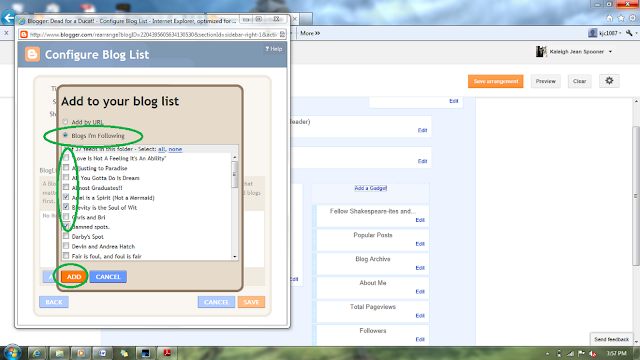
     Alright, geeking out yet again. Really quickly, if you are trying to add a blog that doesn't have a "followers" link to it, all you need to do is copy their address and paste it into the add column of the window as shown, rather than clicking on the "add from blogs I'm following" link. Does that make sense?

   Okay I'll leave you alone now! :)

Friday, January 6, 2012

'Method in The Madness'-A Blogger Tutorial

Alright, I'm geeking out for a little bit. This post will be about the different ways you can connect to other blogs and stay up to date on posts that a published. Specifically, I'll focus on the ways you can employ the "Blogger" website to follow blogs.

So what are the steps?

Step 1:
     Simply go to the blog that you want to follow and click on the "Join this site button" underneath the "Followers" widget.


Step 2:
     Once you click on the tab, you'll see a pop-ut. Click on the "Follow this blog" button. You can either follow publically or privately.


 Step 3:
     Next, you'll return to your blogger dashboard. You can get there by typing in: www.blogspot.com and logging in if necessary. You'll see your reading list, which will display the blogs that you currently follow and the most recent updates for each blog. Voila one way to keep track of everything!


Step 4:
     While still on the dashboard page, you'll click on the dropdown box of the blog you want to add your list of blogs you follow. You'll click on the layout tab and will be taken to the layout of your blog.


Step 5:
     From that point you'll click on the "Add a gadget" link on the sidebar of your blog layout. It will allow a pop-up window to appear. You'll scroll down to the app. called "Blog list" and click the add button.

From here you'll see another pop-up window where you can configure you're list. You'll click on the "Add to list" button.

You'll see yet another pop-up window where you can add links to your blog list. To make things easy, simply click on the "Blogs I'm following" tab and a list of the blogs in your reading list will appear. Then all you have to do is click on the blogs you want in your list and hit "Add"!

After that window closes, make sure you hit the "Save" button. 

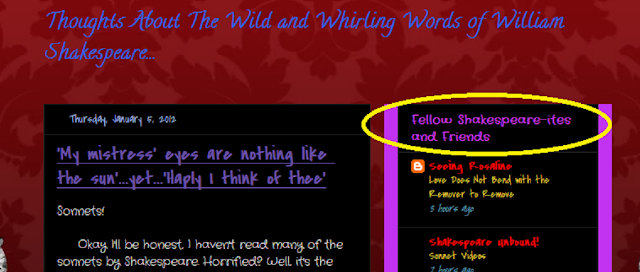
And Voila! You have a widget of all the blogs you follow available on your blog!


Alternative Following Methods:
     There are several other ways to follow blogs as well and I'll go over them quickly. You can scroll to the bottom of someone's blog and select the "subscribe" link available there. This will allow you to see updates they make. You can receive updates in your e-mail and even on your desktop! Or, you can share your blogs on Facebook and Twitter by having the link to your blog exported after you post! Further, you can also use the "Networkedblogs" app. available through Facebook.

Pretty cool right?! Maybe? Sorta?